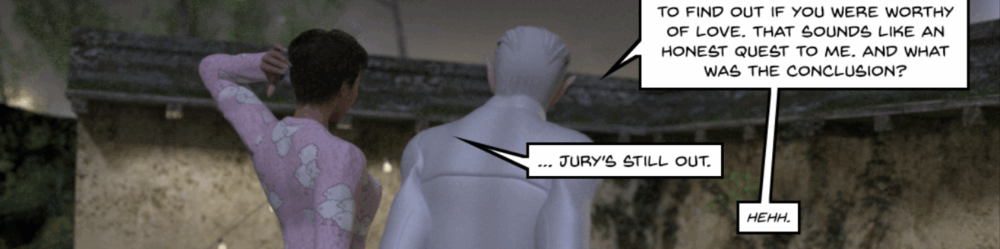

(This is a long lead-in to an update about the comic I’m working on, bear with me). I just watched the recently re-done He-Man [aka Masters of the Universe].
As a child of the eighties, I can honestly say … no. They tried to make the film edgy and sarcastic (which, as a student of the nineties, I can understand), but … it’s a no. It’s a shame because the ingredients are there; money, ego, muscles, dishonouring black women and fat women at every possible opportunity … oh no wait, those are the ingredients for confused bullshit in which the ‘sense of humour’ is mockery-based. Ah. Um …
There’s even a moment when the baddie gets run down by an actual Amazon delivery van! Oh, Bezos. Need you encroach on creative projects in this way? Really? Can’t you think of any more creative ways to insert product placement? … no. Of course you can’t. Poor dear.
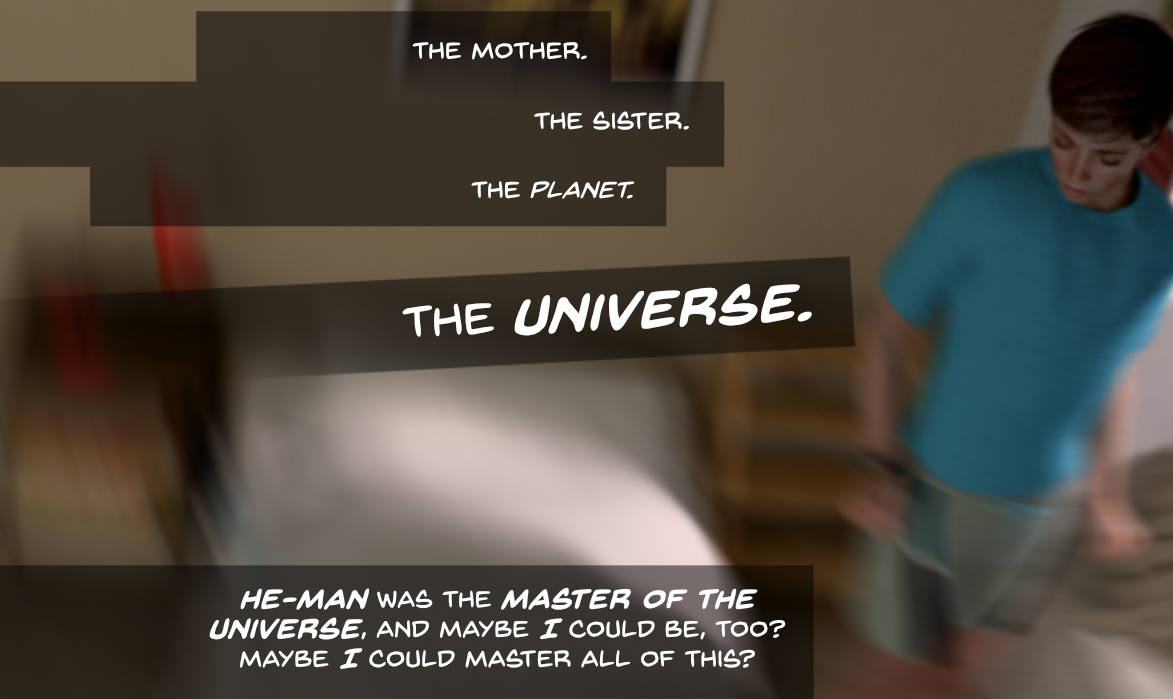
Anyway, on the topic of He-Man, one of the crucial moments in my upcoming ‘backyard’ / ‘twins’ comic, is to do with this precise topic, and he even quotes He-Man because the comic is set in 1983, and so our guy would be well versed in the dead-end philosophy of the muscle-bound approach to life.
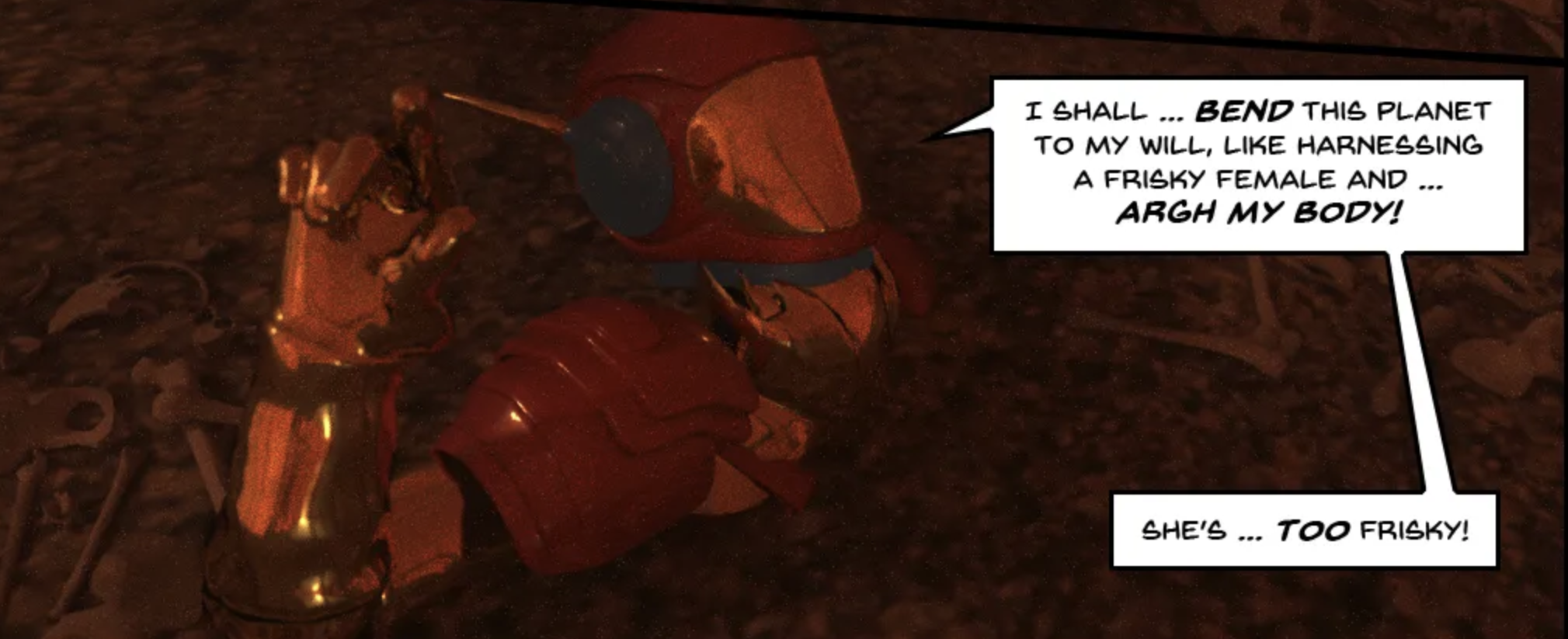
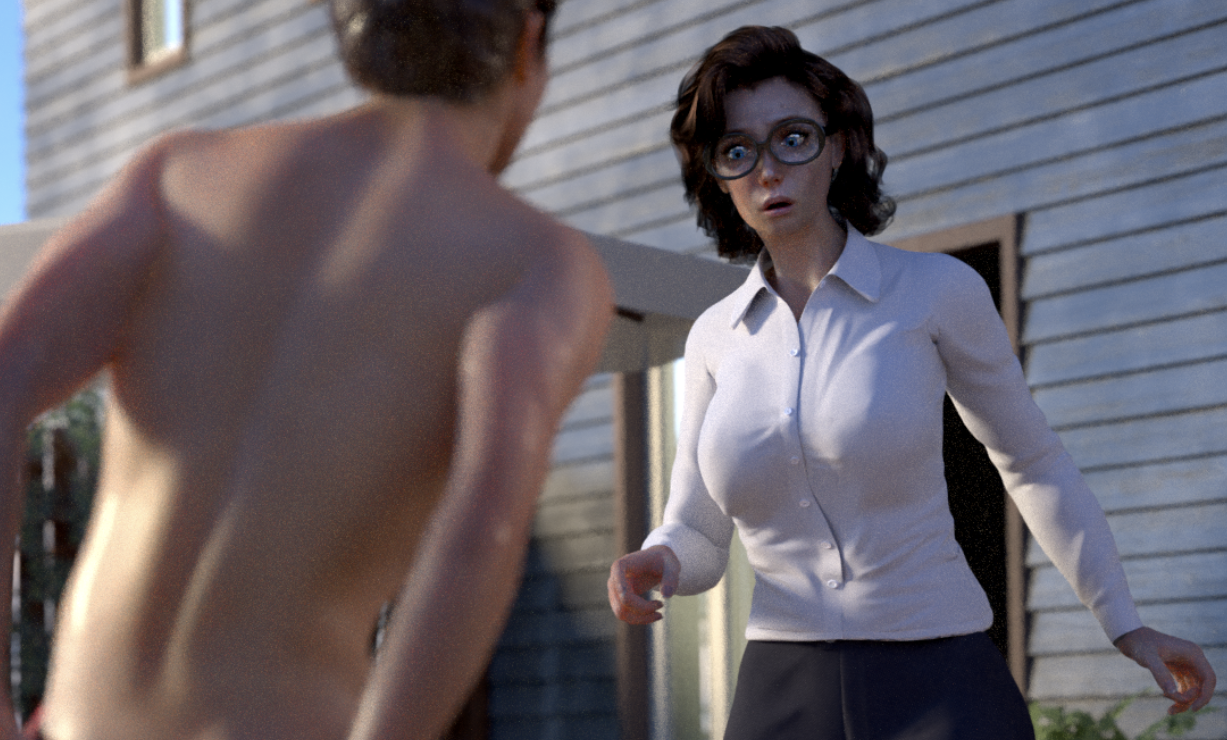
As a very minor spoiler, here he is at a crucial moment, hitting the limits of his Very Difficult Day:
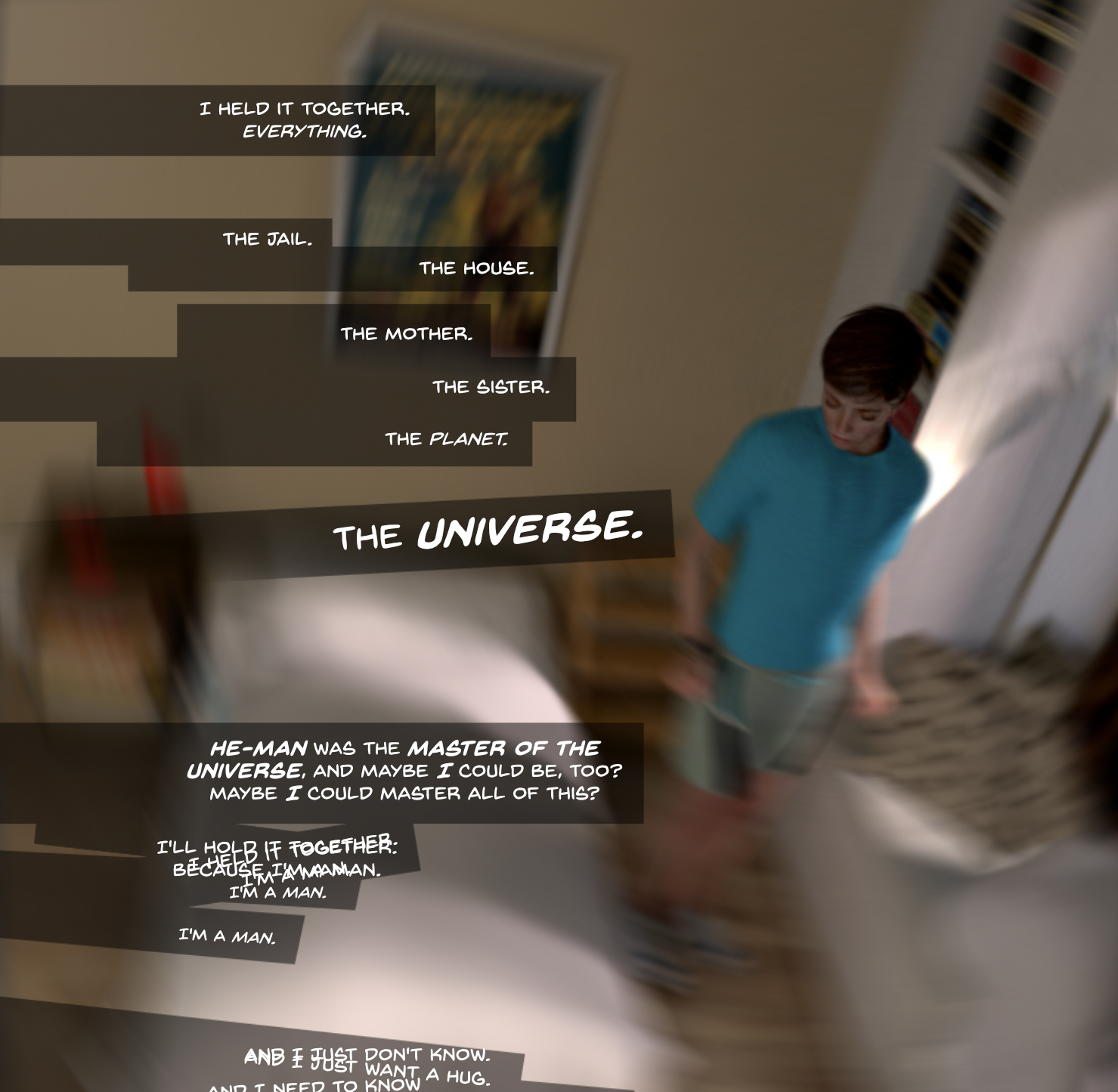
… for the Lore fans out there, this is Kal’s Dad, John Archer. [Kal kept the mother’s surname through their split, hence him being named Kal Smit, but patriarchally he’s Kal Archer.] In 1983 John Archer is 18, which means he has time to grow up, marry and help produce young Kal just in time for Kal’s lockdown shenanigans with his aunt Anna by 2020.
Anyway, point is I created that He-Man reference page 2 years ago (this comic is one of about 20 that’s been on the back-burner for a bit, sitting on a dusty hard drive), but as I’ve been working on the comic recently and having seen the new He-Man film, it did make me think I should blog about it because it’s an important issue; where do we go when things hit the fan? So let me rant on this film for a second, let’s dissect it a little …
Although the Barbie film was superior in so many ways, this did remind me of Barbie; it’s trying to make good points, but there’s so much room for it to be misunderstood, argued about, and confusing to people.
Underneath it all is a good concept; human discovers the importance of living life to certain values. But it seems the mistake so often made is to accidentally fetishise the opposite along the way.
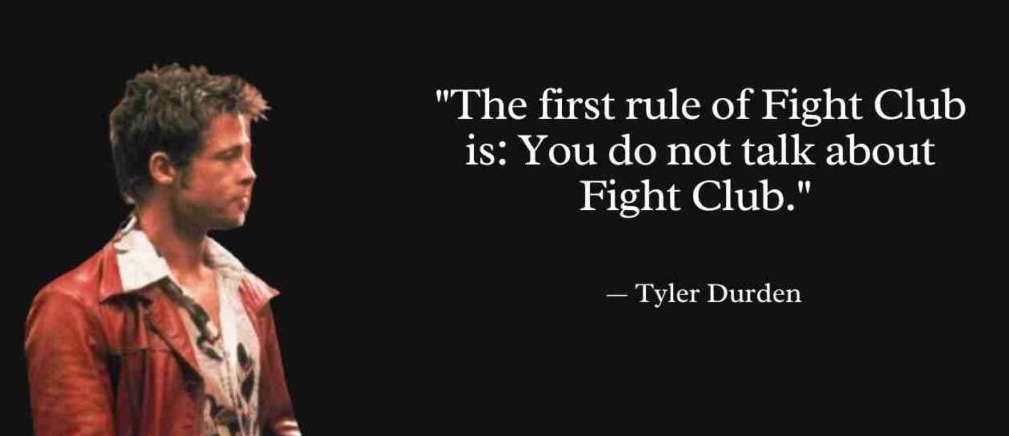
Fight Club: was written to point out the issues with toxic masculinity … and was accidentally mistaken for a Bible on how to be a ‘real man’ by the type of dickheads shown in the film.
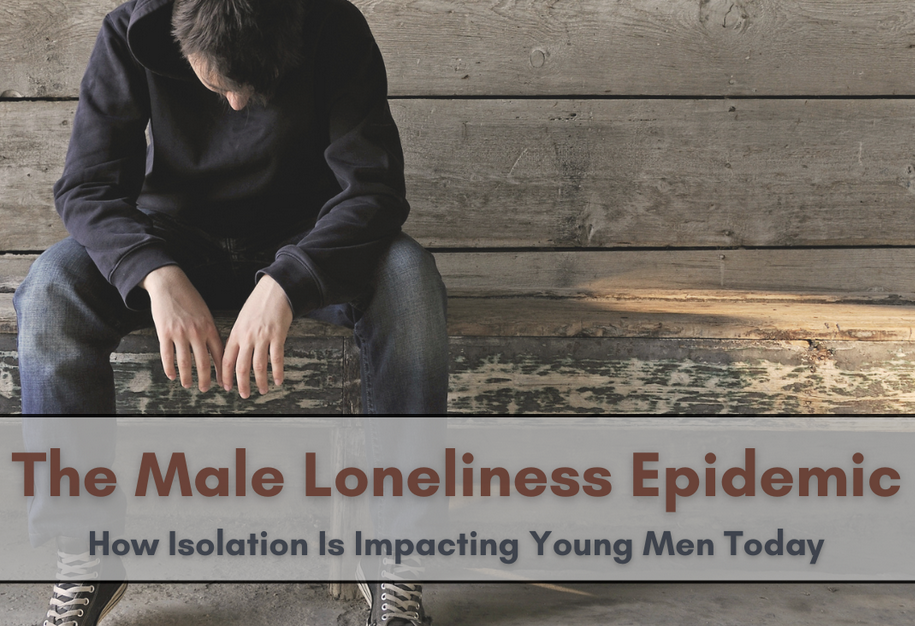
Barbie: written to explore the same topics from another direction, accidentally platforms toxic feminism (I know, let’s manipulate men through lies, problem solved ..).
In He-Man I feel like the problem is the same; to profoundly dishonour those who would work for inclusivity in order to make a point later in the film. The problem is, the average watcher forgets the meta story and just watches it at face value … ‘Oh, they’re doing inclusivity training and it’s annoying … YEAH I SO AGREEEEEE’. That’s the issue. It’s bred out of good writing getting wrecked by boardroom dudebros having a say in the direction; you end up with contradictory bollocks. Every time.
Plus Skeletor was a constantly-CGI’d blancmange of crap. Honestly, it’s worse than The Phantom Menace … lots of nice costumes. That never once feel like real life, despite the budget. It just feels like lots of disconnected cosplay actors trying to out-sarcasm each other. Do I want to watch that? Not particularly.
The risk is that the non-thinking observer sees that stuff [so obviously sourced in the funding boardroom] and goes “Oh yeah, I hate equality too!” … not drawing the parallel to the later point [sourced in the original writing] in which our lad He-Man has learnt his lesson, who then draws on the entire community and knows everyone as individually valid (FISTO is well referenced here, fair enough). But it seems to be a human thing that when the balance is wrong, we forget the lesson and instead we remember the individual moments.
This is the Austin Powers disease; if 90% of the plot showcases the bad thing in order to make a point … people don’t remember the point, they just … see the bad thing. And emulate it.

In Barbie we remember the scene on the beach where women ‘get power’ by manipulating the Kens and causing them to fight each other [golf clap], and we look up to that. Achieves the opposite of the point.
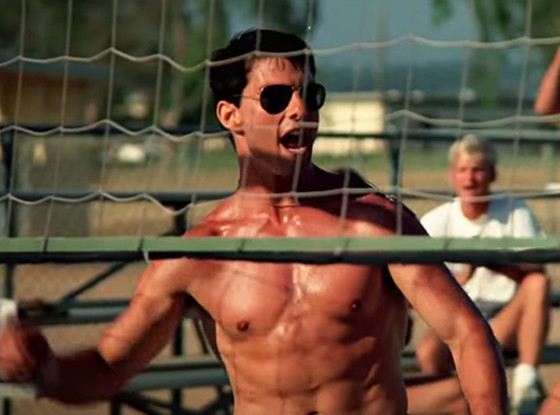
In Fight Club we remember when our guy travels around the country and gets respect from men who he’s beaten up [golf clap], and we look up to that. Achieves the opposite of the point.
In He-Man we remember when he struggles to fit into the world where people are different and progressive and trying to be kind to each other, and we remember how good it feels when Skeletor punches those people [golf clap], and we look up to that. Achieves the opposite of the point. It showcases a confused philosophy in which inclusivity is bizarrely shown to be the opposite of ‘true’ masculinity … as if masculinity relies on (1) having power, and (2) wielding it against others. This is the testosterone-injected homo erotic vision of masculinity we so often see coming from Fascism, which currently means … ‘Merca (sorry Americans, but … you know); the subtly homosexual AND homophobic.
 This is an adolescent mistake made by those perpetrating the idea that ‘Might is Right’. We see it in the Manosphere bellends who do so much damage, who refer to women as ‘Foids’. It seems this Manosphere bollocks is devoid of true father figures, so makes protein-shake pumped-up stand-ins, and like most internalised hang-ups, leads us into a mindset where we want to fuck our problems. Funny stuff. He-Man is not only no exception, it’s the flag-waving, father-lacking, fear-avoiding, female-invalidating textbook on the subject.
Like most things, there are good moments too. The film showcases some of the gorgeous architectural solutions of ancient Somerset; Wells Cathedral’s iconic pillar reinforcement become a geometric theme that runs through the film. I do like films where I can go “Ooh! I’ve actually stood there, right where Skeletor is … flexing …”. There are obviously some brains at work on this project, and it must be doubly annoying to them when it comes through the boardroom stage in tatters like this. I really feel for those writers and set designers who see their hard work thrust through the Bellend Factory and must spend their remaining energy facepalming.
Ah, humans eh? Take something good and turn it into total shit that 100% lacks any true self awareness, clarity, or purpose. How’s that reflecting pool coming along? These things aren’t actually that hard, they just become difficult when our personal values are on fire.
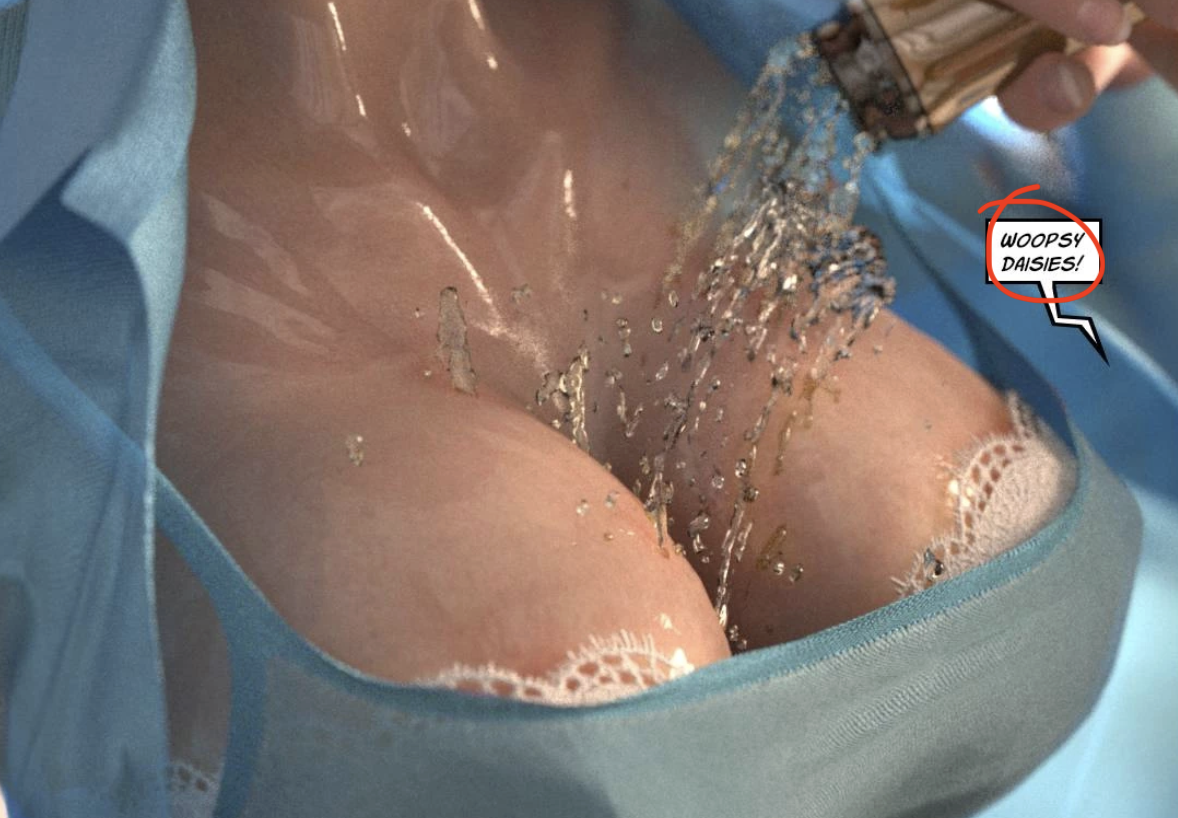
On the plus side, Mamdani exists, and my new comic is on the way. Bit by bit. Boob by boob.


Yeah, I watch films superficially, largely because my flavor of neuro-spiciness means I have trouble simultaneously watching and thinking. Meaning I am generally left dissatisfied / clueless with most movies above slapstick comedy. (Monty Python Are Gods. I call my morning strolls “a visit to the Ministry of Hilly Walks”.)
Despite my single-focus attention issues (which made helped make me a very good engineer), I do see and appreciate many technical aspects of a film, though I find most to be stifling. Such as directors and cinematographers who refuse to pull back to give me more complete context for a scene before diving into its depths. I often feel constrained and restrained and am ultimately lost by the explicit limitation of my focus and the scope of my attention as the camera bobs and weaves.
That’s one reason I like well-produced comics. I can pause on a particular frame and soak in it for a few moments. Pay attention to the framing and the details, the character expressions and the dialog, the lighting and coloring. Separate from and in addition to the initial plot-driven pass through. Then move on when I’m fucking ready. Same for books (but not audio books).
Those pauses are also when I can take time to fall into the philosophical context and implications, where I sometimes can get a bit lost and have to back up a bit before continuing, with my ponderings still fresh in my mind. Instant re-readability!
Your comics (and blog) provide much food for thought, much craft and art to appreciate, and many layers to probe and ponder. Sure, I wish I could operate at the levels needed to glean such gestalts from film, but I’m at least glad I can appreciate them when you so wonderfully present them for my consumption in your comics and blog.
I don’t always agree, which is good, because it encourages me to dig deeper and explore. Often to learn it’s a more a difference of perspective rather than a meaningful difference of opinion.
He-Man was always camp but it was hopeful. The movie just made him into a bumbling idiot. It ruined what made the 80s cartoon fun coupled with some life lessons. Avatar: The Last Airbender (animated), carries a lot that, fun with hope and life lessons along the way. I always recommend it to friends who have kids. I did enjoy Jared Leto’s take on Skeletor, no Alan Oppenheimer, but made the character humourous and annoying in equal measure. The set pieces were great. I wish we had more Cringer. The recent animated mini-series by Kevin Smith was good, this movie should have taken a page from that.
where´s the boobies ?
i´ve tried and tried to grasp what¨s tis all¨bout – seems don´t I get it – since there´s no (.) (.) – i miss boobies – gimme boobies
Exclusivity will always, ultimately, fail. As Red Green so pithily put it “We’re all in this together”.
I also am a child of the ’80s and was cautiously optimistic about this movie because what I saw looked so good and the Idris Elba of it all.
It lost me early on, though, because during the training Man-At-Arms kept yelling the how to be a man crap. This was not the Man-At-Arms I remembered from the cartoon. This was no longer the inventor/engineer that I sort of, kind of, would never say out loud, wanted to be my dad. This was an asshole. But at least he said he appreciated Adam.
Then immediately came King Randor verbally and physically abusing his son in front of all the other children. And I got mad because the King Randor I remembered loved Adam with all his heart because Adam was his son, apparent laziness and all. Why did the movie change a father who loves his unconditionally into a fucking bag of shit?
Geezus, why aren’t men allowed to be kind and show love to men who don’t live up to some bullshit “masculine ideal”?
Unfortunately, I don’t think this problem came out of the boardroom. I think it was there from the beginning.
Thanks for the the blog, Jones.
Ah you listened to more of it than I did then – I sort of skipped through it a bit and I’m glad I missed the bits you mentioned, cos yeah … that is exactly the problem, ‘alphas’ making movies where love is conditional. So annoying.